
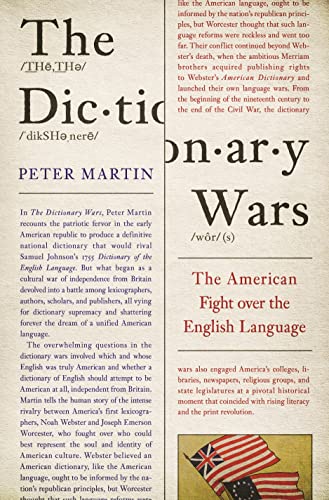
The dictionary wars : the American fight over the English language / Peter Martin.
Material type: TextPublication details: Princeton, N.J. : Princeton University Press, 2019.Description: x, 358 p. : illISBN:
 - 9780691188911 (hbk.)
- 0691188912 (hbk.)
- 9780691210179 (pbk.)
- 0691210179 (pbk.)
- American fight over the English language : the American fight over the English language [Portion of title]
- Dic*tion*ar*y wars [Cover title]
- PE1611 .M37 2019
 Books
Books
| Item type | Home library | Shelving location | Call number | Status | Barcode | |
|---|---|---|---|---|---|---|
|
Books
|
Punsarn Library | General Stacks | PE1611 .M37 2019 (Browse shelf(Opens below)) | Available | PNLIB21060050 |
Includes bibliographical references (p. 333-347) and index.
Part one. Noah Webster's battles. British mockery and American disdain ; Noah Webster: "The wildest innovator" ; Webster's first dictionary ; Displacing Delilah ; The lexicographer's fifth column ; Tea and copyright: Goodrich takes over ;Spelling wars: the rise of Lyman Cobb ; The "common thief" ; Webster's decline -- Part two. The Merriams at war. Taking Webster out of Webster: from family feuds to the Merriam Brothers ; Waiting for Worcester ; The Bohn affair ; Converse's complaint ; Children, money, and "trash" ; High stakes: "Have we a national standard of language?" ; The "terrible rival": Worcesterian resurgence; The Merriams triumphant: "Worcester! Worcester! all change for Webster!" -- Conclusion -- Appendix A: The "Webster" brand -- Appendix B: Four centuries of selected dictionaries of the English language -- Appendix C: Publishing terms -- Appendix D: "The spelling bee at Angels (reported by Truthful James)," / by Bret Harte.
"A compelling history of the national conflicts that resulted from efforts to produce the first definitive American dictionary of English. ... [English professor] Peter Martin recounts the patriotic fervor in the early American republic to produce a definitive national dictionary that would rival Samuel Johnson's 1755 Dictionary of the English Language. But what began as a cultural war of independence from Britain devolved into a battle among lexicographers, authors, scholars, and publishers, all vying for dictionary supremacy and shattering forever the dream of a unified American language. The overwhelming questions in the dictionary wars involved which and whose English was truly American and whether a dictionary of English should attempt to be American at all, independent from Britain. Martin tells the human story of the intense rivalry between America's first lexicographers, Noah Webster and Joseph Emerson Worcester, who fought over who could best represent the soul and identity of American culture. Webster believed an American dictionary, like the American language, ought to be informed by the nation's republican principles, but Worcester thought that such language reforms were reckless and went too far. Their conflict continued beyond Webster's death, when the ambitious Merriam brothers acquired publishing rights to Webster's American Dictionary and launched their own language wars. From the beginning of the nineteenth century to the end of the Civil War, the dictionary wars also engaged America's colleges, libraries, newspapers, religious groups, and state legislatures at a pivotal historical moment that coincided with rising literacy and the print revolution. Delving into the personal stories and national debates that arose from the conflicts surrounding America's first dictionaries, The Dictionary Wars examines the linguistic struggles that underpinned the founding and growth of a nation." --
There are no comments on this title.