
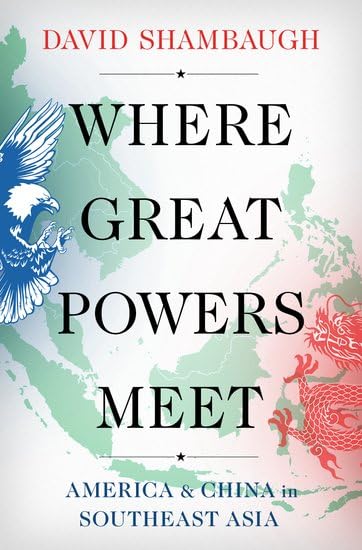
Where great powers meet : America & China in Southeast Asia / David Shambaugh.
Material type: TextPublication details: New York, NY : Oxford University Press, c2021.Description: xx, 326 p. : ill., mapsISBN:
 - 9780190914974 (hardcover)
- 0190914971 (hardcover)
- Southeast Asia -- Foreign relations -- 21st century
- United States -- Foreign relations -- China
- China -- Foreign relations -- United States
- United States -- Foreign relations -- Southeast Asia
- Southeast Asia -- Foreign relations -- United States
- China
- Southeast Asia -- Foreign relations -- China
- United States -- Foreign relations -- 21st century
- China -- Foreign relations -- 21st century
- DS525.8 .S53 2021
 Books
Books
| Item type | Home library | Shelving location | Call number | Status | Barcode | |
|---|---|---|---|---|---|---|
|
Books
|
Punsarn Library | General Stacks | DS525.8 .S53 2021 (Browse shelf(Opens below)) | Available | PNLIB21060804 |
Includes bibliographical references and index.
"Great power rivalry is back. On the complicated landscape of international relations today one predominant factor is rising to the fore: comprehensive competition between the United States and People's Republic of China. This competition is now playing out across all functional domains-diplomacy, commerce, security, intelligence, ideology and values, science and technology, and others-as well as across all continents and many countries. This book is about how the two powers are competing in one geostrategically important part of the world: Southeast Asia. For the United States, the shift from "engagement" to "competition" with China has been the product of a seismic shift in American thinking about China in recent years. Over the past decade a variety of constituencies became progressively more frustrated with Chinese behavior in their respective professional spheres: the U.S. military, diplomats, educators, members of Congress, media and journalists, NGOs of a wide variety, intelligence and law enforcement agencies, and especially the business community. As a result of these growing frustrations with trying to carry on what should be normal cooperative interactions with Chinese counterparts, a progressive groundswell in antipathy and shift in attitudes about China occurred among these constituencies and across the country"-- Provided by publisher.
There are no comments on this title.