
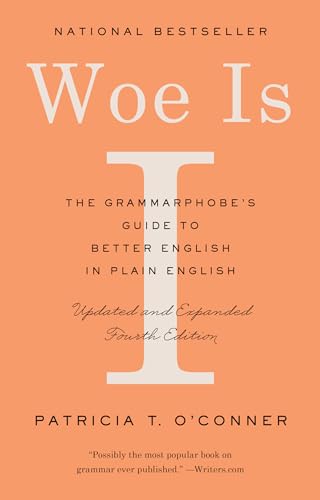
Woe is I : the grammarphobe's guide to better English in plain English / Patricia T. O'Conner.
Material type: TextPublication details: New York : Riverhead Books, 2019.Edition: 4th ed., Updated and expandedDescription: xxii, 298 pISBN:
 - 9780525533054
- 0525533052
- PE1112 .O26 2019
 Books
Books
| Item type | Home library | Shelving location | Call number | Status | Barcode | |
|---|---|---|---|---|---|---|
|
Books
|
Punsarn Library | General Stacks | PE1112 .O26 2019 (Browse shelf(Opens below)) | Available | PNLIB21060958 |
Browsing Punsarn Library shelves Close shelf browser (Hides shelf browser)
Includes bibliographical references and index.
Woe is I: Therapy for pronoun anxiety -- Plurals before swine: Blunders with numbers -- Yours truly: The possessives and the possessed -- They beg to disagree: Putting verbs in their place -- Verbal abuse: No-nos, yeses, and maybes -- Spellbound: How to be letter perfect -- So to speak: Talking points on pronunciation -- Comma sutra: The joy of punctuation -- The compleat dangler: A fish out of water -- Death sentence: Do cliches deserve to die? -- The living dead: Let bygone rules be gone -- Saying is believing: How to write what you mean.
In this expanded and updated edition of Woe Is I, former editor at The New York Times Book Review Patricia T. O'Conner unties the knottiest grammar tangles with the same insight and humor that have charmed and enlightened readers of previous editions for years. With fresh insights into the rights, wrongs, and maybes of English grammar and usage, O'Conner offers in Woe Is I down-to-earth explanations and plain-English solutions to the language mysteries that bedevil all of us. "Books about English grammar and usage are ... never content with the status quo," O'Conner writes. "That's because English is not a stay-put language. It's always changing--expanding here, shrinking there, trying on new things, casting off old ones ... Time doesn't stand still and neither does language." In this fourth edition, O'Conner explains how the usage of an array of words has evolved. For example, the once-shunned "they," "them," and "their" for an unknown somebody is now acceptable. And the battle between "who" and "whom" has just about been won, O'Conner says (hint: It wasn't by "whom"). Then there's the use of "taller than me" in simple comparisons, instead of the ramrod-stiff "taller than I." "May" and "might," "use to" and "used to," abbreviations that use periods and those that don't, and the evolving definition of "unique" are all explained here by O'Conner.
There are no comments on this title.