
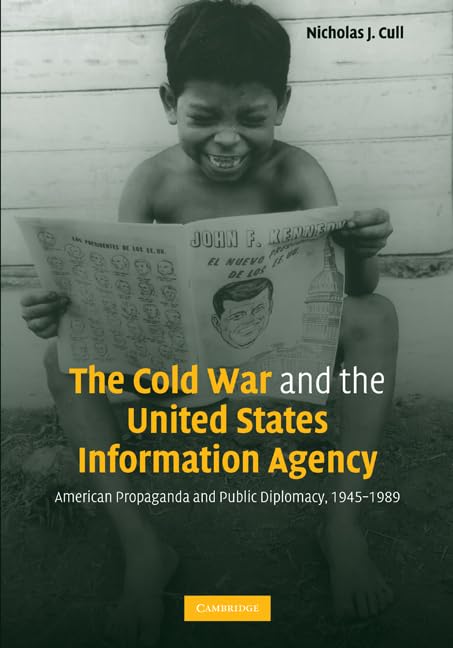
The Cold War and the United States Information Agency : American propaganda and public diplomacy, 1945-1989 / Nicholas J. Cull, University of Southern California.
Material type: TextPublication details: Cambridge, U.K. ; New York : Cambridge University Press, 2013.Edition: 1st pbk. edDescription: xxv, 533 p., 8 unnumbered p. of plates : ill., portISBN:
 - 9780521142830 (pbk.)
- 0521142830 (pbk.)
- E840.2 .C585 2013
 Books
Books
| Item type | Home library | Shelving location | Call number | Status | Barcode | |
|---|---|---|---|---|---|---|
|
Books
|
Punsarn Library | General Stacks | E840.2 .C585 2013 (Browse shelf(Opens below)) | Available | PNLIB21061373 |
Browsing Punsarn Library shelves Close shelf browser (Hides shelf browser)
Reprint. Originally published: 2008.
Includes bibliographical references (p. 505-518) and index.
Proloue: The foundations of U.S. information overseas -- Getting the sheep to speak : the Truman years, 1945-53 -- Mobilizing "the P-factor" : Eisenhower and the birth of the USIA, 1953-56 -- In the shadow of Sputnik : the second Eisenhower Administration, 1957-61 -- Inventing truth : the Kennedy Administration, 1961-63 -- Maintaining confidence : the early Johnson years, 1963-65 -- "My radio station" : the Johnson Administration, 1965-69 -- Surviving détente : the Nixon years, 1969-74 -- A new beginning : the Ford Administration, 1974-77 -- From the "two-way" mandate to the second Cold War : the Carter Administration, 1977-81 -- "Project Truth" : the first Reagan Administration, 1981-84 -- Showdown : the second Reagan Administration, 1985-89 -- Epilogue: Victory and the strange death of the USIA, 1989-99 -- Conclusion: trajectories, maps, and lessons from the past of U.S. public diplomacy.
"Published at a time when the U.S. government's public diplomacy is in crisis, this book provides an exhaustive account of how it used to be done. The United States Information Agency was created, in 1953, to "tell America's story to the world" and, by engaging with the world through international information, broadcasting, culture, and exchange programs, became an essential element of American foreign policy during the Cold War. Based on newly declassified archives and more than 100 interviews with veterans of public diplomacy, from the Truman administration to the fall of the Berlin Wall, Nicholas J. Cull relates both the achievements and the endemic flaws of American public diplomacy in this period."--Publisher description.
There are no comments on this title.