
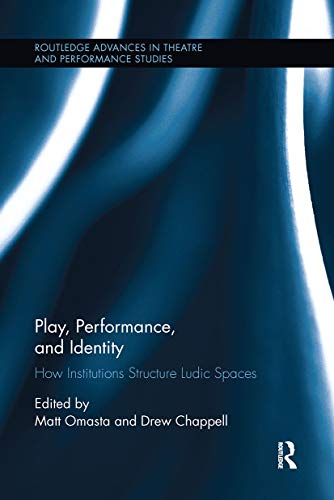
Play, performance, and identity : how institutions structure ludic spaces / edited by Matt Omasta and Drew Chappell.
Material type: TextSeries: Routledge advances in theatre and performance studies ; 35.Publication details: New York : Routledge, 2020.Description: x, 180 p. : illISBN:
 - 9780367738488 (pbk.)
- 0367738481 (pbk.)
- 9781138016774 (hbk.)
- 1138016772 (hbk.)
- GV14.45 .P53 2020
 Books
Books
| Item type | Home library | Shelving location | Call number | Status | Barcode | |
|---|---|---|---|---|---|---|
|
Books
|
Punsarn Library | General Stacks | GV14.45 .P53 2020 (Browse shelf(Opens below)) | Available | PNLIB21062499 |
Reprint. Originally published 2015.
Includes bibliographical references (p. 165-175) and index.
Introduction: play matters / Matt Omasta and Drew Chappell -- Warriors, wizards, and clerics: heroric identity construction in live action role playing games / Dani Snyder-Young -- Homo ludens and the sharks: structuring alternative realities while shark cage diving in South Africa / Michael Schwartz -- Playfully empowering: stunt runners and momentary performance / Terry Brino-Dean -- The future of family play at Epcot / John Newman -- Mormons think they should dance / Megan Sanborn Jones -- All the dungeon's a stage: the lived experiences of commercial BDSM players / Danielle Szlawieniec-Haw -- Cheering is tied to eating: consumption and excess in immersive, role specific dinner theatre spaces / Drew Chappell -- Becoming Batman: cosplay, performance, and ludic transformation at Comic-con / Kane Anderson -- Plaza Indonesia: performing modernity in a shopping mall / Jennifer Goodlander -- Britpicking as cultural policing in fanfiction / Erin Horáková -- Dramatic manipulations: conflict, empathy, and identity in world of Warcraft / Kimi Johnson -- Afterword: who are you? / Matt Omasta & Drew Chappell.
This volume explores how people play and why their play matters, with a particular interest in how ludic experiences are often constructed and controlled by the interests of institutions. From theme parks to comic conventions to massively-multiplayer online games, it probes what roles the designers of these experiences construct for players, and how such play might affect participants' identities and ideologies.
There are no comments on this title.