
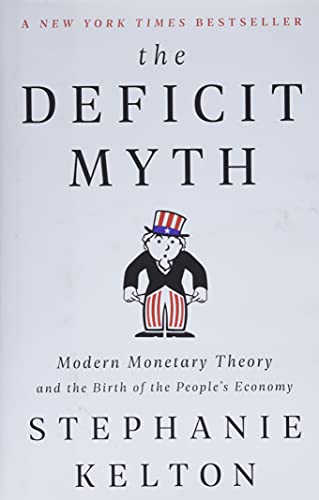
The deficit myth : modern monetary theory and the birth of the people's economy / Stephanie Kelton.
Material type: TextPublication details: New York, N.Y. : PublicAffairs, Hatchette Book Group, 2020.Edition: 1st edDescription: vii, 325 p. : illISBN:
 - 9781541736184 (hardcover)
- 1541736184 (hardcover)
- 9781541757110
- HJ8119 .K45 2020
 Books
Books
| Item type | Home library | Shelving location | Call number | Status | Barcode | |
|---|---|---|---|---|---|---|
|
Books
|
Punsarn Library | General Stacks | HJ8119 .K45 2020 (Browse shelf(Opens below)) | Available | PNLIB21060134 |
Includes bibliographical references and index.
Introduction: Bumper sticker shock -- Don't think of a household -- Think of inflation -- The national debt (That isn't) -- Their red ink is our black ink -- "Winning" at trade -- You're entitled! -- The deficits that matter -- Building an economy for the people.
"Any ambitious proposal - ranging from fixing crumbling infrastructure to Medicare for all or preventing the coming climate apocalypse - inevitably sparks questions: how can we afford it? How can we pay for it? Stephanie Kelton points out how misguided those questions really are by using the bold ideas of modern monetary theory (MMT), a fundamentally different approach to using our resources to maximize our potential as a society. We've been thinking about government spending in the wrong ways, Kelton argues, on both sides of the political aisle. Everything that both liberal/progressives and conservatives believe about deficits and the role of money and government spending in the economy is wrong, especially the fear that deficits will endanger long-term prosperity. Through illuminating insights about government debt, deficits, inflation, taxes, the financial system, and financial constraints on the federal budget, Kelton dramatically changes our understanding of how to best deal with important issues ranging from poverty and inequality to creating jobs and building infrastructure. Rather than asking the self-defeating question of how to pay for the crucial improvements our society needs, Kelton guides us to ask: which deficits actually matter? What is the best way to balance the risk of inflation against the benefits of a society that is more broadly prosperous, safer, cleaner, and secure? With its important new ways of understanding money, taxes, and the critical role of deficit spending, MMT busts myths that prevent us from taking action because we can't get beyond the question of how to pay for it"--
We've been thinking about government spending in the wrong ways, Kelton argues, on both sides of the political aisle. Everything we believe about deficits and the role of money and government spending in the economy is wrong, especially the fear that deficits will endanger long-term prosperity. Kelton uses the bold ideas of modern monetary theory (MMT), a fundamentally different approach to using our resources to maximize our potential as a society. Rather than asking the self-defeating question of how to pay for the crucial improvements our society needs, Kelton guides us to ask: What is the best way to balance the risk of inflation against the benefits of a society that is more broadly prosperous, safer, cleaner, and secure? -- adapted from publisher info
There are no comments on this title.