
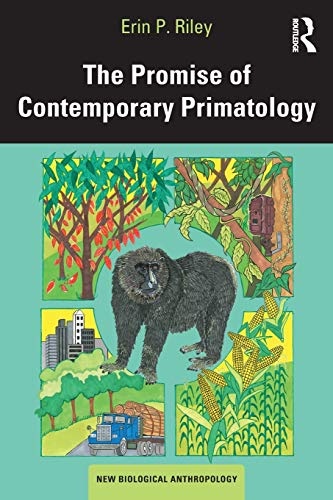
The promise of contemporary primatology / Erin P. Riley.
Material type: TextSeries: New biological anthropologyPublication details: New York, N.Y. : Routledge, 2020.Description: xx, 165 p. : illISBN:
 - 9781629580715 (paperback)
- 1629580716 (paperback)
- 9781629580708 (hardcover)
- 1629580708 (hardcover)
- QL737.P9 R55 2020
 Books
Books
| Item type | Home library | Shelving location | Call number | Status | Barcode | |
|---|---|---|---|---|---|---|
|
Books
|
Punsarn Library | General Stacks | QL737.P9 R55 2020 (Browse shelf(Opens below)) | Available | PNLIB21061548 |
Includes bibliographical references and index.
Introduction: The promise of contemporary primatology -- Franz Boas, American anthropology, and the biological-sociocultural divide -- Primatology : becoming anthropology -- Primatology in anthropogenic contexts : an extended evolutionary approach -- Primatology in anthropogenic contexts : the emergence of ethnoprimatology -- Beyond the divide : fieldwork, reflexivity, and multispecies worlds -- Primate conservation in the twenty-first century and beyond -- Conclusion: Reclaiming primatology as anthropology.
"This book argues for a contemporary primatology that recognizes humans as integral components in the ecologies of primates. This contemporary primatology uses a broadened theoretical lens and methodological toolkit to study primate behavior and ecology in increasingly anthropogenic contexts and seeks points of intersection and spaces for collaborative exchange across the natural sciences, social sciences, and humanities. The book begins by exploring the American tradition of anthropology, providing historical and disciplinary context for the emergence of field primatology and how it became a part of this tradition. It then examines how primatology transformed into a field dominated by evolutionary approaches and highlights how the increasingly anthropogenic environments in which primates live present opportunities to understand primate adaptability at work. In doing so, it explores how an extended evolutionary approach can help explain behavioral variation in these contemporary environments. Focus is then given to the ethnoprimatological approach, a contemporary approach that provides a pluralistic framework, drawing from the natural and social sciences and humanities, needed to study human-primate coexistence in the Anthropocene. Finally, the book considers how such a crossing of disciplines can inform primate conservation in the future. An important interdisciplinary reassessment, this book will be of significant interest to primatologists, biological anthropologists, and scholars of anthropology more generally, as well as evolutionary and conservation biologists"--
There are no comments on this title.