
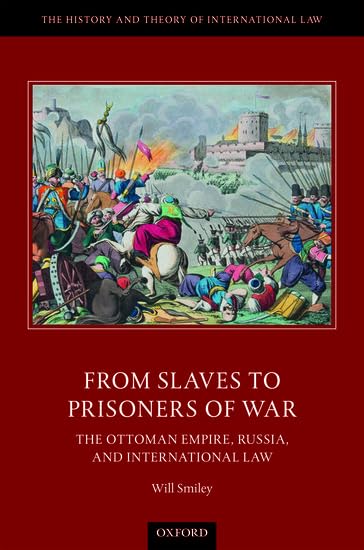
From slaves to prisoners of war : the Ottoman Empire, Russia, and international law / Will Smiley.
Material type: TextSeries: History and theory of international lawPublication details: Oxford, UK : Oxford University Press, 2018.Edition: 1st edDescription: x, 283 p. : ill., mapISBN:
 - 9780198785415 (hbk.)
- 0198785410 (hbk.)
- KZ6495 .S65 2018
 Books
Books
| Item type | Home library | Shelving location | Call number | Status | Barcode | |
|---|---|---|---|---|---|---|
|
Books
|
Punsarn Library | General Stacks | KZ6495 .S65 2018 (Browse shelf(Opens below)) | Available | PNLIB21060020 |
Includes bibliographical references (p. 241-267) and index.
Part I. First Interlude : the Ottoman Empire and its neighborhood -- War and captivity -- Slavery and ransom -- Part II. Second interlude : Imperial conflict and Russian ascendancy -- From the law of ransom to the law of release -- The boundaries of the law of release -- Part III. Third interlude : the 1787 war -- Prisoners of war -- Negotiating the prisoner-of-war system -- Part IV. Fourth interlude : the Age of Revolutions and the "global moment" -- The rules expand -- Those left out -- Part V. Fifth interlude : the nineteenth century -- Military reform, reciprocity, and improved treatment -- Humanitarian law.
The Ottoman-Russian wars of the eighteenth century reshaped the map of Eurasia and the Middle East, but they also birthed a novel concept - the prisoner of war. For centuries, hundreds of thousands of captives, civilians and soldiers alike, crossed the legal and social boundaries of these empires, destined for either ransom or enslavement. But in the eighteenth century, the Ottoman state and its Russian rival, through conflict and diplomacy, worked out a new system of regional international law. Ransom was abolished; soldiers became prisoners of war; and some slaves gained new paths to release, while others were left entirely unprotected. These rules delineated sovereignty, redefined individuals' relationships to states, and prioritized political identity over economic value. In the process, the Ottomans marked out a parallel, non-Western path toward elements of modern international law. Yet this was not a story of European imposition or imitation-the Ottomans acted for their own reasons, maintaining their commitment to Islamic law. For a time even European empires played by these rules, until they were subsumed into the codified global law of war in the late nineteenth century.
There are no comments on this title.