
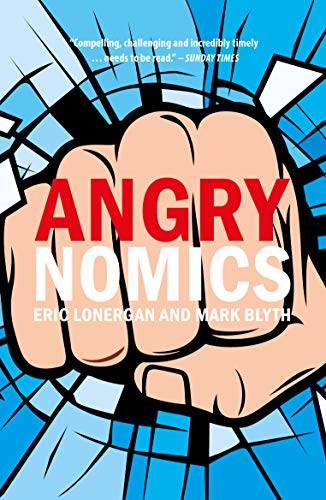
Angrynomics / Eric Lonergan and Mark Blyth.
Material type: TextPublication details: Newcastle upon Tyne : Agenda Publishing Limited, 2020.Description: x, 194 pISBN:
 - 1788212797 (pbk.)
- 9781788212793 (pbk.)
- 1788212789
- 9781788212786 (hbk.)
- HB74.P65 L66 2020
 Books
Books
| Item type | Home library | Shelving location | Call number | Status | Barcode | |
|---|---|---|---|---|---|---|
|
Books
|
Punsarn Library | General Stacks | HB74.P65 L66 2020 (Browse shelf(Opens below)) | Available | PNLIB21060885 |
Includes bibliographical references (p. 177-181) and index.
Introduction: from economics to angrynomics -- Public anger and the energy of tribes -- The moral mobs and their handlers -- Macroangrynomics: capitalism as hardware, with crashes and resets -- Microangrynomics: private stressors, uncertainty and risk -- Calming the anger: from angrynomics to an economics that works for everyone -- Conclusions: what's been said, what's not, and what we don't want to forget -- Postscript: angrynomics in a pandemic.
Economics increasingly fails to explain why the pressures of life appear to be intensifying at the same time as income per capita is rising, or why we work more hours for less money in real terms. And why we see the rise of nationalism everywhere when globalization, on average, has made us all richer. The disconnect between our experience of the world and the economic model used to explain it has given rise to "angrynomics": an economy of heightened uncertainty and anger, where faith in the workings of markets and politics has been undermined and rapid and seemingly ever-accelerating economic change has become something to be feared. Eric Lonergan and Mark Blyth have written a book for anyone anxious, worried - or angry - about the mismatch between how they experience the world with the increasing day to day pressures they face and the model used by economic elites and politicians to explain and justify it. In a powerful and passionately argued analysis, they bring their critical insight and expertise to bear on the nature of angrynomics and offer a set of radical and innovative policies that cut across tired party political lines - and that if implemented might just help the world to be a less angry place.
There are no comments on this title.