
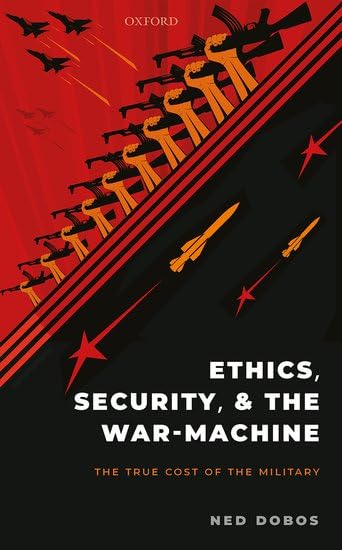
Ethics, security, and the war-machine : the true cost of the military / Ned Dobos.
Material type: TextPublication details: Oxford : Oxford University Press, 2020.Edition: 1st edDescription: vi, 173 pISBN:
 - 019886051X (hbk.)
- 9780198860518 (hbk.)
- U22 .D63 2020
 Books
Books
| Item type | Home library | Shelving location | Call number | Status | Barcode | |
|---|---|---|---|---|---|---|
|
Books
|
Punsarn Library | General Stacks | U22 .D63 2020 (Browse shelf(Opens below)) | Available | PNLIB21060741 |
Includes bibliographical references and index.
If pacifists are correct in thinking that war is always unjust, then it follows that we ought to eliminate the possibility and temptation of ever engaging in it; we should not build war-making capacity, and if we already have, then demilitarization-or military abolition-would seem to be the appropriate course to take. On the other hand, if war is sometimes justified, as many believe, then it must be permissible to prepare for it by creating and maintaining a0military establishment. Yet this view that the justifiability of war-making is also sufficient to justify war-building is mistaken. 0This book addresses questions of jus ante bellum, or justice before war. Under what circumstances is it justifiable for a polity to prepare for war by militarizing? When (if ever) and why (if at all) is it morally permissible to create and maintain the potential to wage war? In doing so it highlights the ways in which a civilian population compromises its own security in maintaining a permanent military establishment, explores the moral and social costs of militarization, and evaluates whether or not these costs are worth bearing.
There are no comments on this title.