
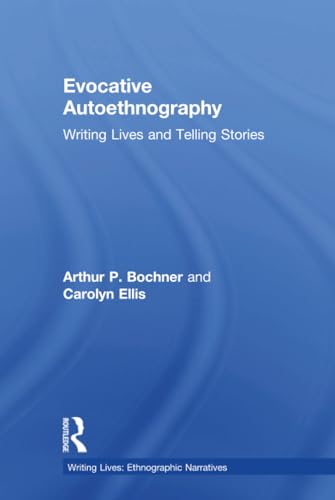
Evocative autoethnography : writing lives and telling stories / Arthur P. Bochner and Carolyn Ellis.
Material type: TextSeries: Writing lives--ethnographic narratives ; 17.Publication details: New York, NY : Routledge, 2016.Description: 330 pISBN:
 - 9781629582146 (hbk.)
- 162958214X (hbk.)
- 9781629582153 (pbk.)
- 1629582158 (pbk.)
- GN346.6 .B634 2016
 Books
Books
| Item type | Home library | Shelving location | Call number | Status | Barcode | |
|---|---|---|---|---|---|---|
|
Books
|
Punsarn Library | General Stacks | GN346.6 .B634 2016 (Browse shelf(Opens below)) | Available | PNLIB21060824 |
Includes bibliographical references and index.
Preface: imagine a workshop on evocative autoethnography -- Part one: origins and history -- Session one: coming to autoethnography -- Session two: the rise of autoethnography -- Part two: composing evocative stories -- Session three: crafting evocative autoethnography -- Session four: thinking with "Maternal connections" -- Part three: ethical dilemmas and ethnographic choices -- Session five: ethical challenges -- Session six: ethnographic alternatives -- Part four: narrative truth: meanings in motion -- Session seven: thinking with "Bird on the wire" -- Session eight: reflecting on truth and memory work -- Coda: restoring harmony -- Appendixes. A. Maternal connections ; B. Groaning from the soul ; C. Bird on the wire.
"This comprehensive text is the first to introduce evocative autoethnography as a methodology and a way of life in the human sciences. Using numerous examples from their work and others, world-renowned scholars Arthur Bochner and Carolyn Ellis, originators of the method, emphasize how to connect intellectually and emotionally to the lives of readers throughout the challenging process of representing lived experiences. Written as the story of a fictional workshop, based on many similar sessions led by the authors, it incorporates group discussions, common questions, and workshop handouts. The book -describes the history, development, and purposes of evocative storytelling; -provides detailed instruction on becoming a story-writer and living a writing life; -examines fundamental ethical issues, dilemmas, and responsibilities; -illustrates ways ethnography intersects with autoethnography; -calls attention to how truth and memory figure into the works and lives of evocative autoethnographers"--
There are no comments on this title.