
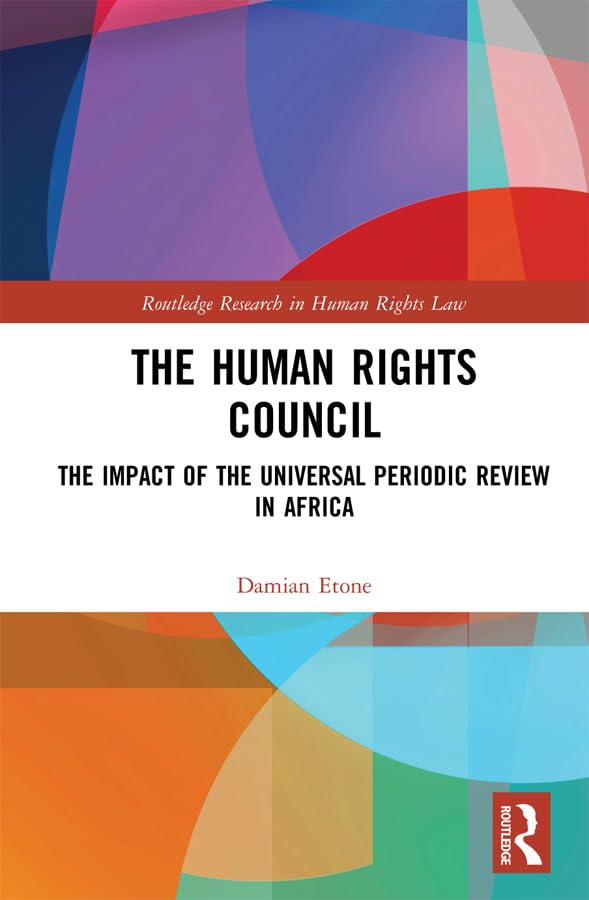
The Human Rights Council : the impact of the Universal Periodic Review in Africa / Damian Etone.
Material type: TextSeries: Routledge research in human rights lawPublication details: Abingdon, Oxon ; New York, NY : Routledge, 2020.Description: xiii, 215 p. : illISBN:
 - 9780367182496 (hardcover)
- 0367182491 (hardcover)
- K3241 .E86 2020
 Books
Books
| Item type | Home library | Shelving location | Call number | Status | Barcode | |
|---|---|---|---|---|---|---|
|
Books
|
Punsarn Library | General Stacks | K3241 .E86 2020 (Browse shelf(Opens below)) | Available | PNLIB21060216 |
Includes bibliographical references and index.
The establishment and operation of the Universal Periodic Review -- Theoretical understanding of the UPR: a case for acculturation? -- Compliance, implementation and effectiveness: clarifying the basis for assessing state UPR engagement -- Nigeria's engagement with the HRC's UPR: potential for acculturation or risk of regression? -- Kenya and the UPR: the impact of effective NGO engagement -- NGOs versus state recommendations and the relationship between the UPR and other human rights mechanisms: the case of Kenya -- The Effectiveness of South Africa's engagement with the UPR: potential for ritualism? -- The Gambia and the UPR: rhetoric, inaction and the effect of regime change.
"This book examines the engagement of African states with the United Nations Human Rights Council's Universal Periodic Review Mechanism (UPR). This system is known for its pacific and non-confrontational approach to monitoring state human rights implementation. Coming at the end of the first two cycles of the UPR, the work offers a detailed analysis into the effectiveness of African states' engagement and its potential impact. It develops a framework which comprehensively evaluates aspects of states' UPR engagement such as the pre-review national consultation process and implementation of UPR recommendations which, until recently, have received little attention. The book considers the potential for acculturation in engagement with the UPR and unpacks the impact of regionalism, cultural relativism, rights ritualism and civil society. The work provides a useful guide for policymakers and international human rights law practitioners as well as a valuable resource for international legal and international relations academics and researchers"-- Provided by publisher.
There are no comments on this title.