
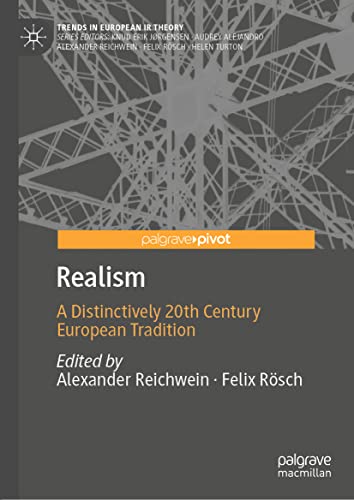
Realism : a distinctively 20th century European tradition / Alexander Reichwein, Felix Rösch, editors.
Material type: TextSeries: Trends in European IR theoryPublication details: Cham, Switzerland : Palgrave Macmillan, c2021.Description: xiii, 154 p. : illISBN:
 - 9783030584542 (hbk.)
- 3030584542 (hbk.)
- JZ1305 .R43 2021
 Books
Books
| Item type | Home library | Shelving location | Call number | Status | Barcode | |
|---|---|---|---|---|---|---|
|
Books
|
Punsarn Library | General Stacks | JZ1305 .R43 2021 (Browse shelf(Opens below)) | Available | PNLIB21061904 |
Includes bibliographical references and index.
Chapter 1. Introduction: Realism : a primarily European tradition emigrating to the U.S.-- Chapter 2. Between Kratos and Ethos: thinking through the ritual in the work of Friedrich Meinecke -- Chapter 3. Edward H. Carr and Carl Schmitt: Interwar realism's not so strange bedfellows -- Chapter 4. Weimar in America: Central European Émigrés, classical realism, or how to prevent history from repeating herself -- Chapter 5. John Herz and the purposes of realism -- Chapter 6. Nicholas Spykman's interactional realism: irony, social theory, political geography -- Chapter 7. The Christian realist pendulum: between pacifism and interventionism -- Chapter 8. The Germans and the frenchmen: Hoffmann's and Aron's critiques of morgenthau -- Chapter 9. When Martians go to Venus: structural realism in Europe.
This book examines how IR's European realist tradition evolved in Europe and, due to emigration, in the United States in the 20th century. It includes an introduction and eight chapters, focusing on historical classical and contemporary structural branches of realist IR theorizing in historical and political contexts in which realist thinking did develop. It reminds us of realist key figures, such as Edward H. Carr, John H. Herz or Hans J. Morgenthau, but also of almost forgotten realists such as Raymond Aron, Stanley Hoffmann or Nicholas J. Spykman. Given IR mainstream textbooks introducing realism as a conservative American Cold War theory, this selection aims to reintroduce realism as a primarily and distinctively European, liberal, normative and critical tradition. A tradition that is almost always misunderstood as a guide for practitioners how to maximize or at least preserve power in the name of the national interest no matter the cost, but that is in fact an argument against reckless and crude power politics, ideology and totalitarianism. This book is an invaluable resource for scholars, practitioners and students interested in the realist tradition in IR. Alexander Reichwein is Lecturer in International Relations at the Department of Political Science at the Justus-Liebig-University Giessen, Germany. Felix Rösch is Associate Professor in International Relations at Coventry University, UK. .
There are no comments on this title.